Australia — Händler- und Beschaffungsführer
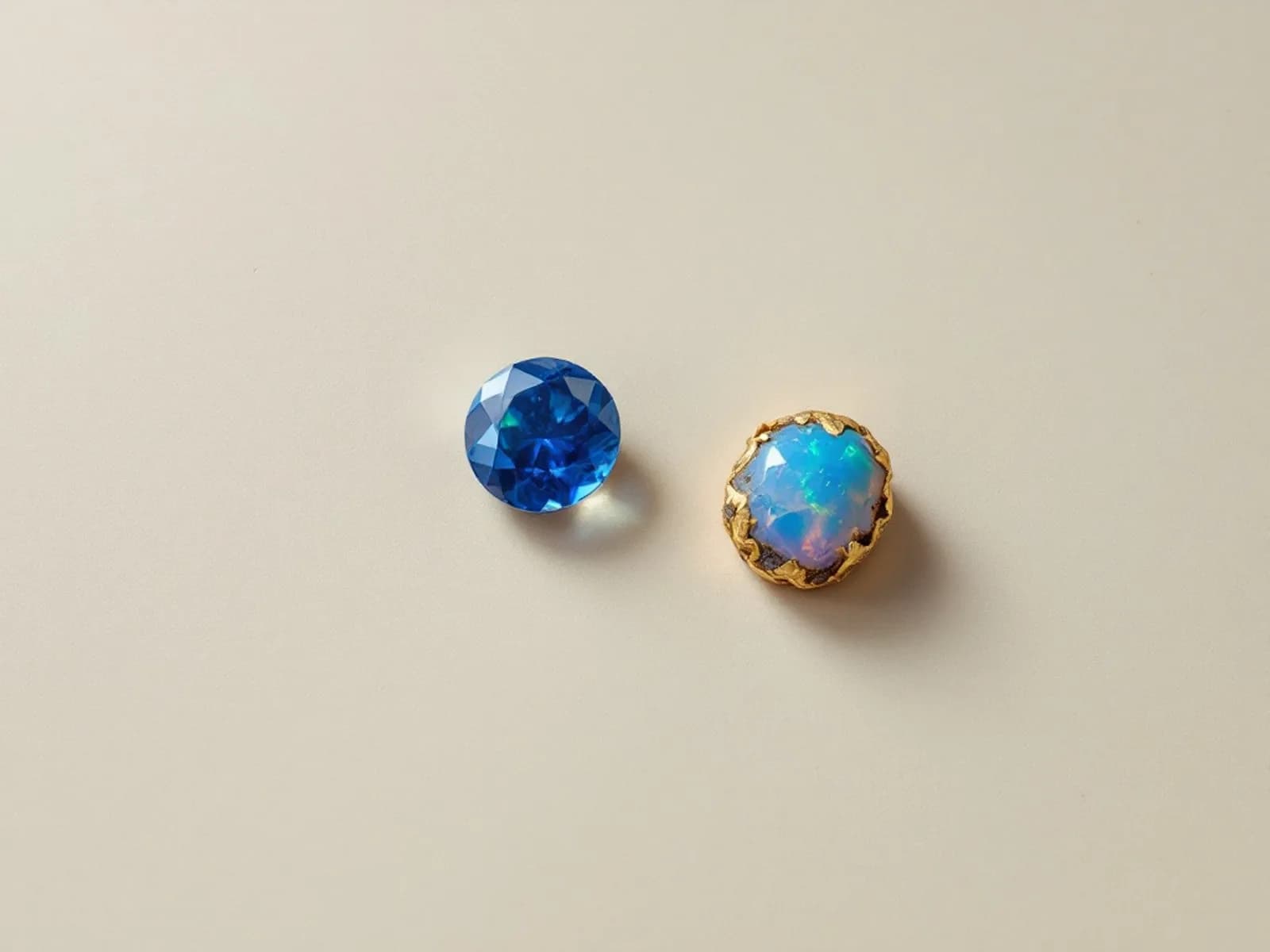
Australia defined the world opal trade for more than a century and remains its reference origin, and its sapphire fields in Queensland and New South Wales supply the market with dependable dark blues, parti colours and the teal that designers cannot get enough of. Few origins combine a luxury phenomenon gem and a workhorse corundum trade in one country. This page covers the opal fields and how opal is graded and sold, the sapphire gemfields, what is and is not treated, and what an honest listing has to say.
The opal fields
Australian opal formed in the weathered sediments of the Great Artesian Basin, and each field cut into that basin has its own character. Lightning Ridge in New South Wales is the home of black opal, the most valuable form of the gem, mined from shallow shafts in ground that has changed little in a century of digging; the first black opal came up there around 1903. Coober Pedy in South Australia, opened in 1915, produces the greater volume in white and crystal opal, with Andamooka nearby and Mintabie, until it closed in 2019, to the north. White Cliffs was the first commercial field, in the 1890s. The Queensland belt, Winton, Quilpie, Yowah and Koroit, yields boulder opal in which the precious material stays attached to its ironstone host and is cut with it.
Buying at the fields is a culture of its own, and much fine rough still changes hands locally before cutting. Miners sell to field buyers, field buyers to Sydney and Hong Kong, and Japan was for decades the largest single market for the finished stone.
How opal is graded
Opal is described by body tone, brightness and pattern before anyone mentions carats. Body tone runs from N1, the blackest, to N9, the palest; black opal is N1 to N4, dark opal N5 to N6, and everything lighter is light or white opal. Brightness is scored on a five-step scale. Pattern names, harlequin, rolling flash, pinfire, broad flash, are used loosely, and harlequin in particular is claimed more often than it is seen. Red on black is the top of the market. Boulder opal is priced by the face rather than the weight, since most of the stone is ironstone.
Solid Australian opal is untreated. It is not hydrophane, so it does not drink water or cloud, which sets it apart from Ethiopian material and is a selling point worth stating. Doublets and triplets, a slice of opal glued to a dark backing and, for triplets, capped with quartz, must be declared as such. Matrix treatments on Andamooka material, where a porous stone is blackened with sugar and acid, must be stated plainly. Synthetic opal exists and a laboratory will spot it by its structure. Laboratories do not usually give a country of origin for opal; a report says natural, synthetic or assembled, and notes treatment. Origin is a matter of the dealer's provenance, which is a reason to buy from one whose provenance can be checked.
Sapphire country
The New England fields around Inverell and Glen Innes, and the gemfields of central Queensland at Anakie, Sapphire, Rubyvale and The Willows, produce sapphire in commercial quantity from basalt-derived gravels. Australia was the largest sapphire producer in the world by volume in the 1980s. The classic output is dark, iron-rich blue, often greenish, plus yellow, green and the parti-coloured stones split between blue, green and yellow that have moved from curiosity to design staple. Teal is the current name for the blue-green end of that range, and it sells.
Most of the dark blue is heated, traditionally in Chanthaburi and Bangkok, to lift and clarify colour, and follows the usual heat conventions: "indications of heating" or H on the report. Parti and teal stones are more often sold unheated, and "no indication of heating" is a positive claim with a premium attached. Laboratories can place Australian sapphire in the basalt-related group by chemistry and inclusions; separating it from Thai, Cambodian or Nigerian basaltic sapphire is harder, and a report may say so rather than guess. GIA, Gübelin, SSEF, GRS, AIGS and Lotus all issue Australia as an opinion when the evidence supports it.
Buying Australian stones
For opal, buy from houses that state solid, doublet or triplet in writing and photograph stones against neutral backgrounds; a black card under a crystal opal makes it look like something it is not. Ask for body tone and brightness, and ask which field the stone came from. For boulder, look at the back as well as the face. For sapphire, ask whether it is heated and where it was heated; ask for the report on anything above 2 ct or anything sold as unheated. Treatment and origin come from an independent laboratory, not from the seller alone.
Buying through the register
The dealers listed on this page have had legitimacy, certification practice and disclosure checked. Ask for the laboratory report where one exists, ask for treatment and assembly in writing, and compare what the listing says with what the report says.
GemsVerified verifies dealers, never the individual stone. The dealer grid below covers both the opal fields and the sapphire trade.
Händler im Register
Alle Elemente im Verzeichnis anzeigen →

Fragen und Antworten
What stones come from Australia?
Black opal from Lightning Ridge, white and crystal opal from Coober Pedy and Andamooka, boulder opal from the Queensland fields, and sapphire from the New England and central Queensland gemfields. Smaller amounts of zircon, chrysoprase and diamond as well. See the verified dealer grid for current availability.
What must be disclosed on opal?
Whether the stone is solid, a doublet or a triplet, and any matrix treatment such as the sugar-and-acid blackening used on Andamooka material. Synthetic opal must be named as such. Verified dealers state this in writing on every listing, and a laboratory report will confirm natural, assembled or synthetic where the price justifies one.
Is Australian sapphire heated?
Most of the dark blue is, usually in Thailand, and the report will read "indications of heating". Parti and teal stones are more often sold unheated and "no indication of heating" carries a premium. Treatment should be established by an independent laboratory, not by the seller's description, on any stone of consequence.
What is black opal?
Opal with a dark body tone, graded N1 to N4 on the trade's scale, against which the play of colour shows most strongly. Lightning Ridge is its home. Black refers to the body, not the colour play; red on black is the most valuable combination. A dark backing glued to a light opal is a doublet, not black opal.
Is Australian opal better than Ethiopian opal?
Different rather than better. Australian opal is not hydrophane, so it does not absorb water, cloud or crack the way some Ethiopian material can, and it has a longer record of stability. Ethiopian opal can be very bright and is much cheaper. A dealer should say which you are looking at, and a laboratory can tell them apart.