Verified Opal dealers & buying guide
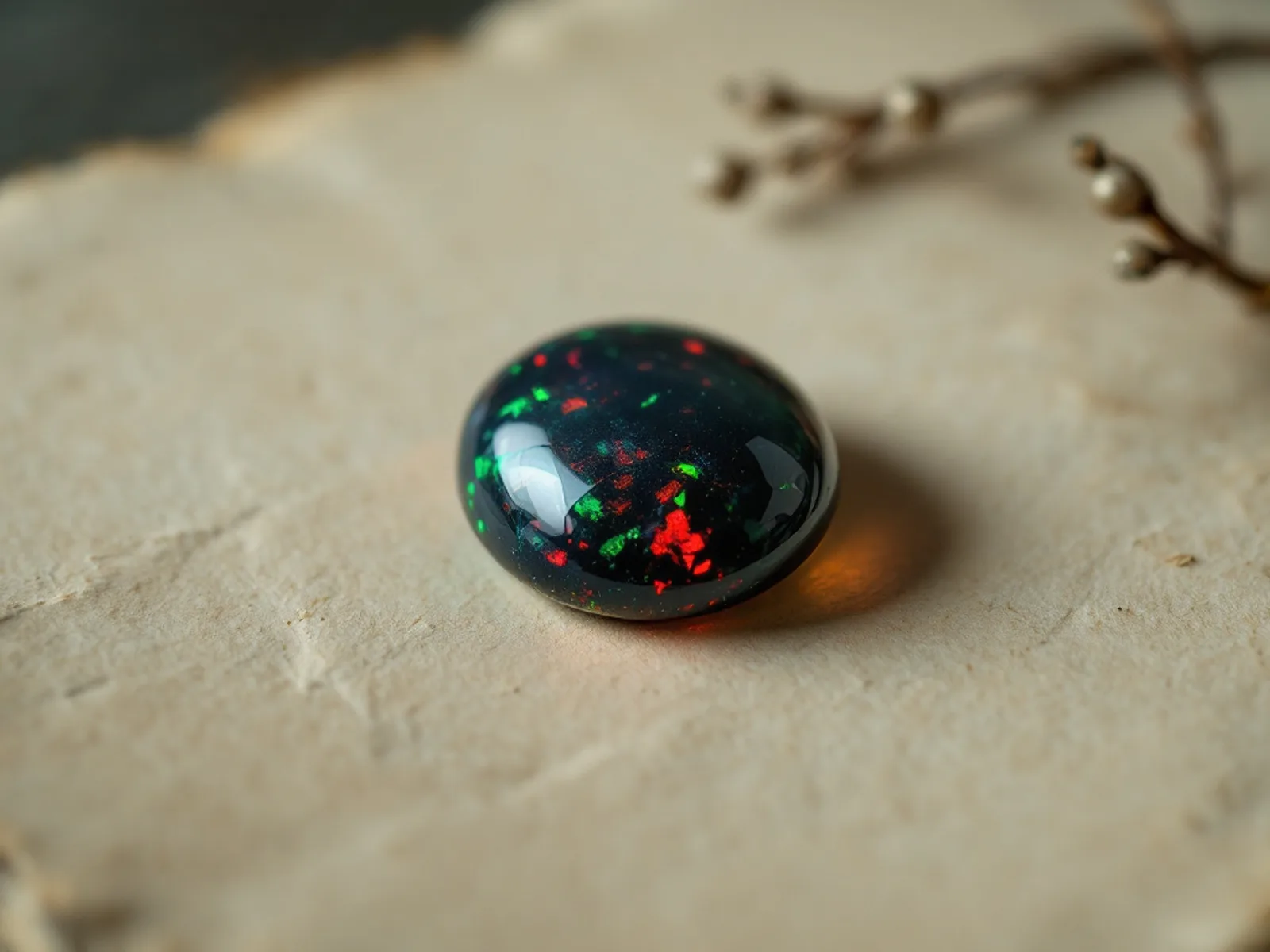
Opal is priced on play-of-colour, the flashes of spectral colour that travel across the stone as it moves. Body tone, brightness, pattern and origin do the rest. Australian material from Lightning Ridge, Coober Pedy and the Queensland boulder fields is the benchmark the trade still measures against; Ethiopian opal from Welo has become the volume source since 2008 and behaves like a different substance in the hand. Below: the types and their vocabulary, Australia against Ethiopia, the treatments and assembled stones you will meet, what a laboratory will say, and how to buy.
Types, tones and the words dealers use
Opal is hydrated silica, laid down from silica-rich water in sedimentary rock and, in some fields, volcanic rock. Play-of-colour comes from ordered silica spheres diffracting light. The trade then sorts precious opal by body tone, N1 (black) through N9 (white), and by transparency.
Black opal has a dark body tone, N1 to N4, and the colour stands out against it. Lightning Ridge in New South Wales is the source that counts, and black opal is the most valuable form. Boulder opal is a thin seam of precious opal on or in ironstone, cut with the host rock left on; Queensland (Winton, Quilpie, Yowah) is the country for it, and the ironstone gives dark contrast without the stone being a black opal. Crystal opal is transparent to semi-transparent with colour showing through the body: Lightning Ridge, Coober Pedy, Ethiopia. "Black crystal" is dark-toned crystal. White or light opal, N7 to N9, is the pale opaque sort from Coober Pedy and Mintabie in South Australia, and from Ethiopia and Brazil.
Fire opal is its own category, transparent orange to red, with or without play-of-colour, and mostly Mexican. Potch is common opal with no play at all.
Brightness runs from faint to brilliant. Pattern names describe the shape of the colour: harlequin, rolling flash, pinfire, broad flash, ribbon. Red is rarest and dearest, then orange, green, blue. A red-on-black harlequin from Lightning Ridge is the top of the market.
Australia against Ethiopia
Australian opal is non-hydrophane. It does not drink water, is stable in ordinary wear, and has been traded for well over a century, so the market for it is settled. Ethiopian opal from the Welo (Wollo) region, found in 2008, is mostly hydrophane. Wet it and it can go temporarily transparent or lose its play; it also takes up oils, dyes and dirt. It recovers when dry, can craze if dried too fast, and because it is porous it accepts treatment easily, which is the point that matters below. Older Ethiopian stone from Mezezo, found in 1994, is volcanic and prone to crazing on its own account.
Ethiopian opal is cheaper than Australian for equal brightness and often shows very bright colour in large clean pieces. It is not inferior in its play; it is a different material to own, with a younger market, and the price should say so. Honduras, Brazil, Mexico, Indonesia and Nevada produce smaller amounts.
Treatments, and stones that are glued together
Solid untreated opal is the norm at the quality end. Below that:
- Smoke treatment: hydrophane opal is wrapped in paper or organic matter and heated so carbon enters the pores and darkens the body to imitate black opal. Common on Ethiopian material.
- Sugar-acid: soaked in sugar solution, then sulphuric acid, depositing carbon in the pores. Long used on Andamooka matrix opal from South Australia; now seen on Ethiopian too.
- Dye. Hydrophane takes it readily. Purple, pink and blue dyed Ethiopian opals are sold openly, and sometimes not.
- Impregnation with resin or oil to fill cracks and stabilise.
- Assembled stones. A doublet is a thin slice of precious opal glued to a dark backing (ironstone, potch, glass or plastic). A triplet adds a clear quartz or glass cap. Both are legitimate products when sold as such and cost a fraction of solid opal.
On the report
GIA, SSEF, Gübelin and AIGS identify natural opal and state whether it is solid, doublet or triplet. They report detected treatments: smoke, sugar-acid, dye, impregnation. Some note hydrophane behaviour. Australian and Ethiopian material can usually be separated on request. Synthetic opal, Gilson, Kyocera and later products, is on the market and is picked up by its columnar "lizard skin" structure.
Price and buying
Body tone: black over dark over light. Brightness, judged in ordinary indoor light rather than under a spotlight. Dominant colour and pattern, red and multicolour broad-flash and harlequin at the top. Solid against assembled, treated against untreated. Origin, since a Lightning Ridge black commands more than an Ethiopian stone of similar appearance. Then size and shape; large solid black opals are scarce.
Ask whether the stone is solid, doublet or triplet, and look at the side and back. A flat, dark, uniform backing with a visible glue line is an assembled stone. Ask the origin and whether the opal is hydrophane. Ask if it has been smoked, sugar-acid treated, dyed or impregnated. Turn it in daylight and in room light; play that only appears under a spotlight is weak. On anything significant, ask for a report stating natural opal, solid or assembled, and treatments.
Watch for doublets and triplets sold as solid; smoked Ethiopian sold as black opal; "Australian" applied to Ethiopian material; and dyed opal sold as natural colour.
Buying through the register
The dealers on this page have had legitimacy, certification practice and disclosure checked by GemsVerified. Ask for the report on any solid black or boulder opal of value. Have the seller state in writing whether the stone is solid, natural-colour and untreated.
GemsVerified verifies dealers, not individual stones. The laboratory report is the record for the stone.
Dealers on the register
View all in directory →
Questions, answered
What is the difference between Australian and Ethiopian opal?
Australian opal is non-hydrophane: it does not absorb water and is stable in wear. Most Ethiopian (Welo) opal is hydrophane: it soaks up water, can go temporarily clear or dull when wet, and takes dye and smoke treatment easily. Ethiopian is cheaper for similar brightness. Ask which you are buying, and for a valuable stone have origin stated on an independent laboratory report.
How can I tell if an opal is a doublet or triplet?
Look at it side-on. A doublet shows a straight, flat join between a thin layer of opal and a dark backing; a triplet has a clear domed cap on top as well, often visible as a bubble-like layer. Stones set with closed backs are harder to check, so ask the seller in writing and, for anything of value, get a laboratory report stating solid, doublet or triplet.
Is black opal treated?
Natural black opal from Lightning Ridge is normally untreated. The problem is hydrophane opal, mainly Ethiopian, darkened by smoke or sugar-acid treatment to pass as black opal. GIA, SSEF and Gübelin can detect these treatments and state them on the report. Any inexpensive "black opal" offered without a report should be treated as suspect until proven otherwise.
Can opal get wet?
Australian solid opal can be worn in water without harm, though soap and heat are best avoided. Hydrophane Ethiopian opal absorbs water and may lose its play-of-colour or turn transparent until it dries out; it can craze if dried too quickly, and it soaks up oils and dyes. Ask whether your stone is hydrophane before it goes anywhere near a sink.
Does opal need a certificate?
For inexpensive stones, no. For any solid black, boulder or crystal opal of value, ask for a report from an independent laboratory stating natural opal, whether it is solid or assembled, and any treatments detected. Origin (Australian or Ethiopian) can usually be given. On treatment and assembly, the seller's description alone is not enough.