Verified Moonstone dealers & buying guide
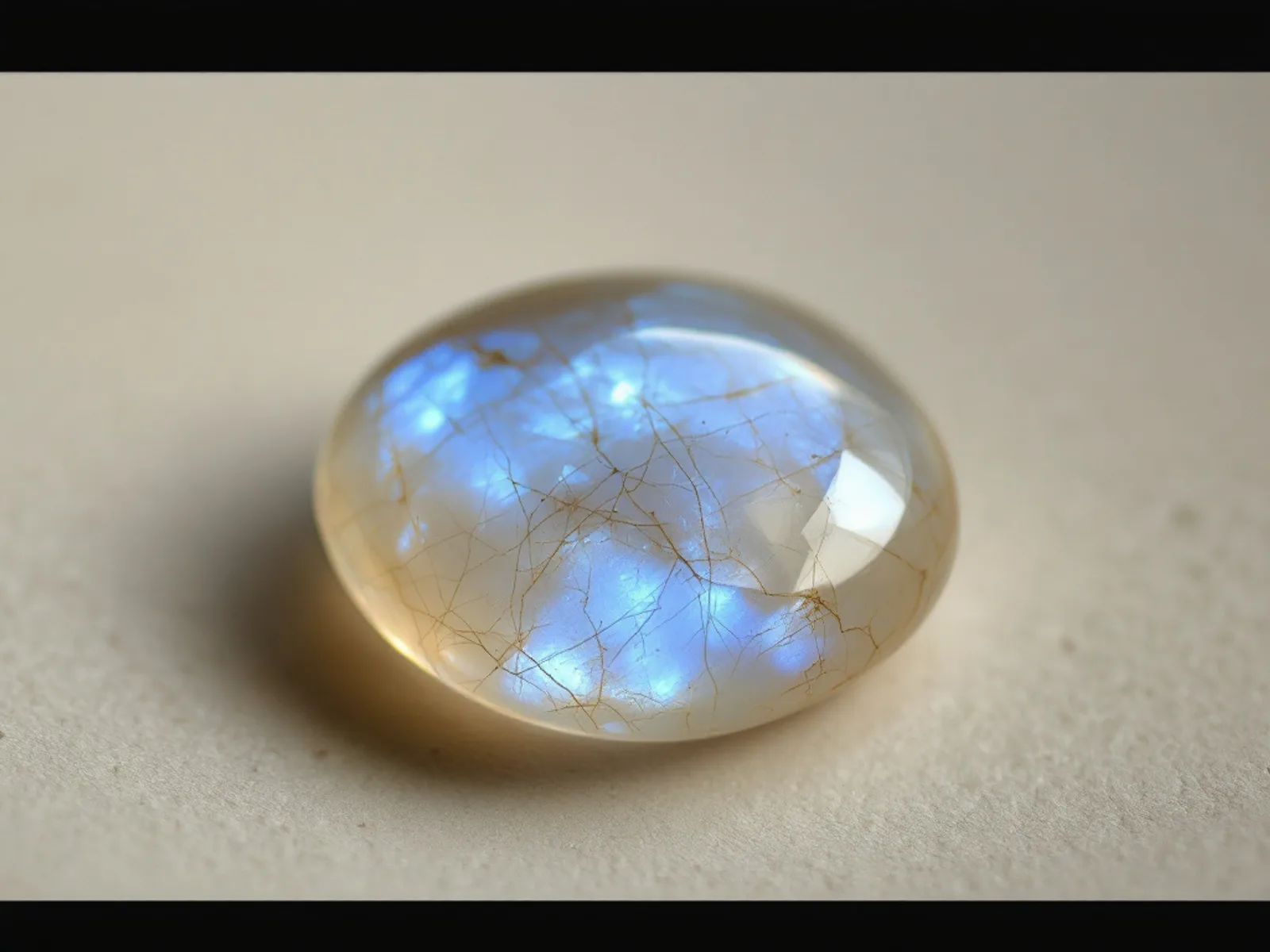
Moonstone is graded on its sheen before anything else. The soft billow of light that rolls across the dome as the stone turns is called adularescence, after adularia, the feldspar of the Adula massif in Switzerland. It occurs because two feldspars, orthoclase and albite, separated into microscopic layers as the crystal cooled, and those layers scatter light. That is as much of the physics as a buyer needs. What follows covers the grading vocabulary the trade uses, Sri Lanka set against India, what gets sold under the moonstone name without being moonstone, why the cut decides the price, and what to ask.
How a moonstone is graded
Nobody grades moonstone on paper. It is done by eye, across a counter, and the vocabulary is settled enough that two dealers usually agree within a grade. A colourless body close to transparent gives the best effect, since the light then seems to rise from inside the stone rather than sit on its surface. The sheen itself wants to be a cold electric blue. Silvery white sits some way below, and the milky glow that reads as haze rather than light belongs at the commercial end. How the sheen moves matters as much as what colour it is. It should centre on the dome and travel edge to edge as the stone tilts, and a sheen that slides off to one side or flashes from a point and dies has cost the cutter most of the value. Scarcity tells late but hard, because fine Ceylon blue above 10 ct is now difficult to find and the price does not creep, it steps.
Body colours other than colourless are common enough. India sends peach, grey, green and brown material, cat's eye stones, and the four-rayed star moonstone that turns up in Jaipur parcels. Rainbow moonstone needs a caveat. It is white labradorite with a blue and multicoloured schiller, and any laboratory will report it as labradorite. Sold honestly under its trade name it is cheap and attractive, but it is not the Ceylon stone and should not be priced as one.
Meetiyagoda, and everything else
Sri Lanka sets the standard. The blue sheen material comes from a small area around Meetiyagoda, inland from Ambalangoda, worked by pit and shaft for the best part of a century and giving up less with each decade. That alone explains what a fine 10 ct Ceylon stone now costs. India supplies the volume in every body colour, and most of the moonstone in high street jewellery starts there. Tanzania and Madagascar fill in behind. Mogok has produced fine blue sheen stones in the past, though never in commercial quantity, and Switzerland survives only in the word.
Laboratories will identify the species and name the variety, but they do not offer an origin opinion on moonstone. A Ceylon label therefore rests on the dealer's own records and on nothing else. Ask where a stone was cut as well as where it was mined. Most Ceylon rough is still cut on the island, and a cabochon off a good Ratnapura or Beruwala bench is easy enough to tell from a rushed one.
The dome is not a convention
Moonstone is cut en cabochon because that is how the phenomenon is made to appear. The scattering layers lie in a single plane, and the cutter has to orient the dome so that plane runs parallel to the base. A few degrees out and the sheen slides towards one edge or disappears, which is why two stones from the same rough can differ by a multiple in price. High domes concentrate the light and read strongest. Shallow ones spread it thin and are cut that way to hold weight. Faceted moonstone exists and can be handsome, though it is bought for body colour, not for the phenomenon.
Treatment is not the issue here that it is elsewhere. Nothing improves adularescence, and nothing accepted is done to the stone. Coatings and foil-backed composites appear at the bottom of the market. Substitution is the more frequent problem: opalescent glass sold as opalite or sea opal, and treated quartz, both wearing the moonstone label in tourist shops. Glass gives a static milkiness rather than a rolling sheen, and a hand lens will usually find the gas bubbles.
Wear, price and what to ask
At six on the Mohs scale, with easy cleavage, moonstone belongs in pendants and earrings, and in rings worn with some thought rather than on the working hand. Bezel and half-bezel settings protect the girdle and the dome edge, and the stone should stay out of the ultrasonic.
Ceylon blue leads on price, with fine Indian blue behind it and the coloured bodies further down. Past that the questions are simple enough. Whether a stone is orthoclase moonstone or labradorite catches most people out, and where it was cut tells you as much about the sheen as where it was mined. Coatings and backings have to be asked about directly, since nobody volunteers them. On a stone of any weight, ask for a laboratory identification. It will not settle origin, but it settles species, and for a gem judged entirely by eye that is the one fact worth having on paper.
Buying through the register
The moonstone dealers listed here have been checked by GemsVerified for legitimacy, certification practice and disclosure, and have set out how they source and declare. For a phenomenon gem graded by eye, that is the sensible place to begin.
Ask for species and treatment in writing, and for a laboratory identification on anything of weight. GemsVerified verifies dealers, not individual stones. The sheen you judge for yourself, in daylight, with the stone moving.
Dealers on the register
View all in directory →
Questions, answered
What makes one moonstone worth more than another?
The sheen does most of it. A cold blue sheen that centres on the dome and rolls from edge to edge, over a colourless and near transparent body, is the top of the market. Silvery white comes below it and a milky haze below that again. Fine Ceylon blue above 10 ct has become scarce, and prices at that weight reflect it.
Is moonstone treated?
Fine moonstone is not, because no accepted enhancement improves adularescence and the honest answer on most stones is none. Coatings, foil-backed composites and outright substitutes do turn up at the cheap end, which is why a written statement of species and treatment is worth having even on a gem the trade does not routinely cook.
Is rainbow moonstone really moonstone?
Not in the laboratory sense of the word. Rainbow moonstone is white labradorite showing a blue and multicoloured schiller, mostly from India, and an independent report will name it labradorite rather than moonstone. The trade name is accepted and the material is attractive at its price, but it is not Ceylon blue sheen stone and should not cost like one.
Where does the best moonstone come from?
From Sri Lanka, and specifically the workings around Meetiyagoda in the south west, which give the colourless blue sheen stones the trade calls Ceylon moonstone. India supplies far more by volume, in peach, grey and green. No laboratory issues an origin opinion on moonstone, so a Ceylon label rests on the dealer's sourcing records rather than on any report.
Can moonstone be worn every day?
With a protective setting and a certain amount of care. It is six on the Mohs scale and cleaves easily, so a knock against a hard edge can chip or split it, which is why bezels suit it and ultrasonic cleaners do not. Earrings and pendants take considerably less punishment than a ring on the hand you actually use.